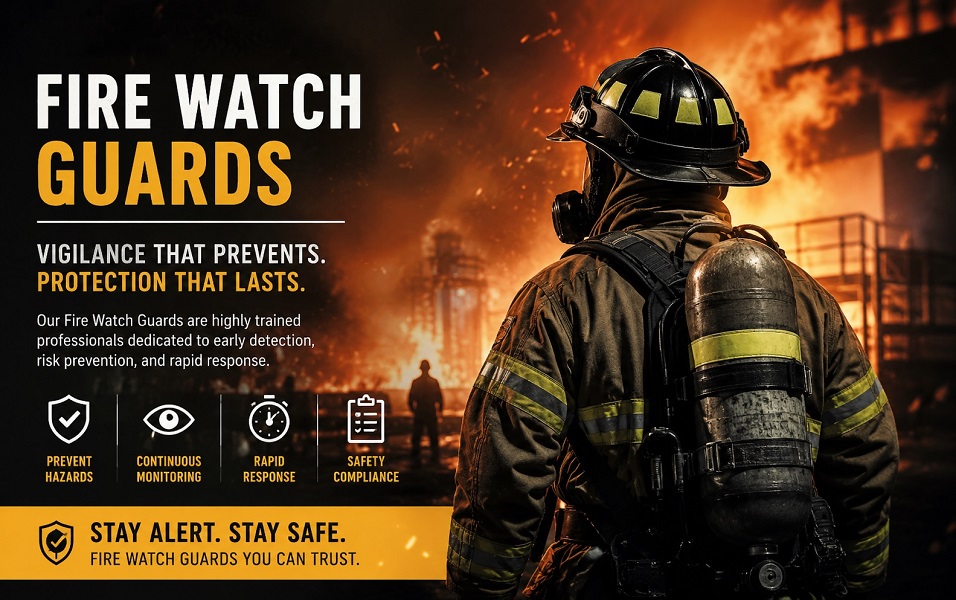
When the Alarm Goes Silent, Everything Changes
Picture this: your building’s fire suppression system goes offline at 11 p.m. on a Wednesday. Maintenance can’t get there until morning. Your tenants are asleep on the upper floors. Your sprinklers are inactive. Your alarm network is dark. What stands between your property and a catastrophic fire? If you’re managing a commercial building, a residential high-rise, or an industrial facility, the honest answer should always be the same — a trained, certified, and alert human being on patrol. That human being is a fire watch guards, and understanding their role isn’t just smart building management. It’s the difference between a close call and a headline.
Fire safety is evolving rapidly. As buildings grow taller, construction timelines get compressed, and aging infrastructure creates new vulnerabilities, the demand for specialized fire watch services has surged across the United States. Building managers who once treated fire watch as a bureaucratic checkbox are now recognizing it as a mission-critical operational layer — one that directly impacts insurance premiums, regulatory standing, and the lives of everyone inside.
What Fire Watch Actually Means — And Why It’s Misunderstood
Ask ten building managers to define fire watch and you’ll get ten different answers. Some confuse it with general security patrol. Others assume it’s only required during active construction. The reality is far more nuanced — and far more urgent.
A fire watch is a formally designated monitoring protocol in which trained personnel conduct continuous or scheduled patrols throughout a property to detect fire hazards, verify that safety systems are functional, and trigger emergency response when a threat is identified. It is most commonly deployed when a building’s primary fire detection or suppression systems are temporarily compromised — during alarm system repairs, sprinkler upgrades, power outages, or hot work operations like welding and cutting.
The National Fire Protection Association’s NFPA 601 standard governs fire watch security comprehensively, outlining guard qualifications, patrol frequency, documentation requirements, and coordination protocols with local fire departments. OSHA also issues guidance for fire watch during hot work environments, making compliance a dual-regulatory concern for many facilities. Ignoring either framework isn’t just a compliance risk — it’s a liability exposure that no property manager should accept.
The Anatomy of a Properly Executed Fire Watch
There’s a common misconception that placing any warm body with a clipboard near a fire exit constitutes a valid fire watch. It doesn’t. A legitimate, code-compliant fire watch program has structure, rigor, and documentation standards that mirror the discipline of a professional security operation.
Under NFPA 601, patrol intervals must be conducted at regular intervals — typically every 15 to 30 minutes — across all areas of the property, including zones with elevated hazard profiles. Guards carry the responsibility of maintaining clear sightlines, identifying smoldering materials, checking for blocked fire exits, and verifying that extinguisher equipment is charged and accessible. Every patrol must be logged with time, location, findings, and any corrective actions taken.
Post-hot-work monitoring is one of the most overlooked requirements in building management. After welding, cutting, or other heat-generating operations conclude, fire watch services must continue for a minimum of 30 minutes to one hour. Fires ignited by residual embers or superheated materials can take hours to manifest — and by then, the construction crew has long gone home.
Who These Guards Are — And What Sets the Best Apart
The best fire watch personnel aren’t simply security officers handed a different assignment. They are specialists who understand combustion behavior, building evacuation architecture, fire code geography, and emergency communication protocols. The top-tier providers in the U.S. — including companies like Just Fire Watch, which has built a strong operational reputation in the field — deploy guards equipped with OSHA credentials, NFPA training certifications, GPS tracking tools, and the situational awareness to manage multi-floor patrols in high-pressure environments.
Qualifications matter enormously. NFPA 601 requires that fire watch guards complete a recognized training program covering fire safety principles, hazard detection methods, suppression equipment use, and emergency communication procedures. Guards must also demonstrate familiarity with the specific layout and risk profile of the assigned building — a requirement that demands thorough pre-deployment briefings between the provider and the building manager.
What separates an exceptional guard from a mediocre one comes down to three qualities: discipline, alertness, and communication. A guard who can spot a smoldering electrical panel at 3 a.m. and immediately coordinate with both building management and the local fire department — calmly, accurately, and without hesitation — is the professional your building deserves.
When Building Managers Are Legally Required to Deploy Fire Watch
Compliance isn’t optional. Across most U.S. jurisdictions, building managers are legally required to initiate a fire watch under specific, well-defined conditions. Understanding these triggers isn’t just regulatory hygiene — it’s operational self-defense.
Fire watch deployment is typically mandated when:
- A fire alarm system or sprinkler system is taken offline for maintenance, repair, or testing for more than four hours in a 24-hour period
- Hot work permits are issued for welding, grinding, or cutting operations inside or adjacent to the building
- A fire protection system suffers an unexpected failure or malfunction
- Structural alterations create temporary conditions that compromise passive fire protection features
- Local fire authority inspections identify conditions requiring human monitoring as a compensatory measure
The International Fire Code, enforced at the local level across most states, mirrors NFPA standards in these requirements. Non-compliance can result in stop-work orders, fines, permit revocations, and — in the event of a fire — devastating legal exposure. Insurance carriers are also increasingly scrutinizing fire watch compliance records when underwriting commercial property policies.
The Documentation Discipline That Protects Your Building — and You
Here’s a detail that many building managers overlook until it’s too late: documentation isn’t an administrative formality. It’s your legal shield.
Every fire watch log entry — timestamped, location-specific, and guard-verified — creates a compliance record that can protect your organization in the event of a fire investigation, insurance claim dispute, or regulatory audit. Digital verification systems now allow guards to log patrols via mobile apps with GPS coordinates and photo documentation, creating irrefutable timestamps that paper logs simply can’t provide.
When selecting a fire watch provider, building managers should specifically ask how logs are stored, how they can be accessed in real time, and how they are formatted for regulatory submission. A provider who can’t answer these questions clearly isn’t operating at a professional standard. The paper trail is as important as the patrol itself.
Choosing the Right Fire Watch Partner for Your Building
The fire watch services market in the United States has grown significantly, and not all providers are created equal. Building managers face a real challenge in separating certified, operationally sound firms from companies offering cut-rate coverage with undertrained personnel.
When evaluating a fire watch provider, the questions worth asking go beyond price. Does the company carry adequate liability insurance? Are its guards NFPA-trained and OSHA-credentialed? Can it deploy within the required timeframe — often within an hour of a system failure? Does it have experience with your building type, whether that’s a mixed-use high-rise, an industrial warehouse, a healthcare facility, or a construction site?
Response speed is non-negotiable. A system outage at midnight cannot wait until morning for coverage. The providers who distinguish themselves in this space — including established operations like Just Fire Watch — have built infrastructure around rapid deployment, 24/7 availability, and seamless coordination with local fire authorities. That infrastructure is what you’re actually paying for.
The Human Layer That Technology Can’t Replace
Building automation is advancing at a remarkable pace. Smart fire detection systems, AI-driven sensor networks, and cloud-connected suppression infrastructure are transforming how modern buildings manage risk. Yet every advancement in fire safety technology carries with it a single unavoidable vulnerability: systems fail.
Sensors malfunction. Software glitches. Power surges knock out control panels. Pipe failures disable sprinkler networks. And when the technology goes dark, it is the physical presence of a trained, alert, credentialed fire watch guard that stands between your building and an uncontrolled fire.
There is something irreducibly human about fire watch that no algorithm has managed to replicate. A guard who notices an unusual smell in a utility corridor at 2 a.m., who spots a smoldering piece of insulation above a drop ceiling, who recognizes that a fire door has been propped open in a stairwell — these are the micro-observations that prevent macro-disasters. The buildings that understand this principle don’t wait for a system failure to find out whether they have the right partner in place. They act before the alarm ever goes silent.